Planet Zoo 2 Money Making Guide: Economy Explained
How money works in Planet Zoo 2: the official build-attract-earn-expand loop, shops and amenities, education income, and breeding animals to trade in Franchise.
Money in Planet Zoo 2 is not complicated, but it is unforgiving if you expand faster than your income. This guide explains the official economy loop Frontier has described, breaks down each confirmed income system, and covers the Franchise-mode trading economy — without inventing a single number the community has not verified.
What Is the Official Economy Loop in Planet Zoo 2?
Frontier describes Planet Zoo 2’s economy as a five-step cycle:
Build habitats → attract guests → boost your zoo rating → earn money → expand.
Every income system in the game hangs off this loop. Habitats draw guests. Happy, educated guests raise your zoo rating. A higher rating pulls more guests and unlocks better income. That money funds the next habitat, which restarts the cycle at a bigger scale.
The practical lesson: there is no single “money building.” Income is a byproduct of zoo quality. A zoo with one excellent habitat and good facilities out-earns a zoo with five neglected ones, because welfare, guest happiness, and rating are all chained together.
How Do Shops and Amenities Make Money?
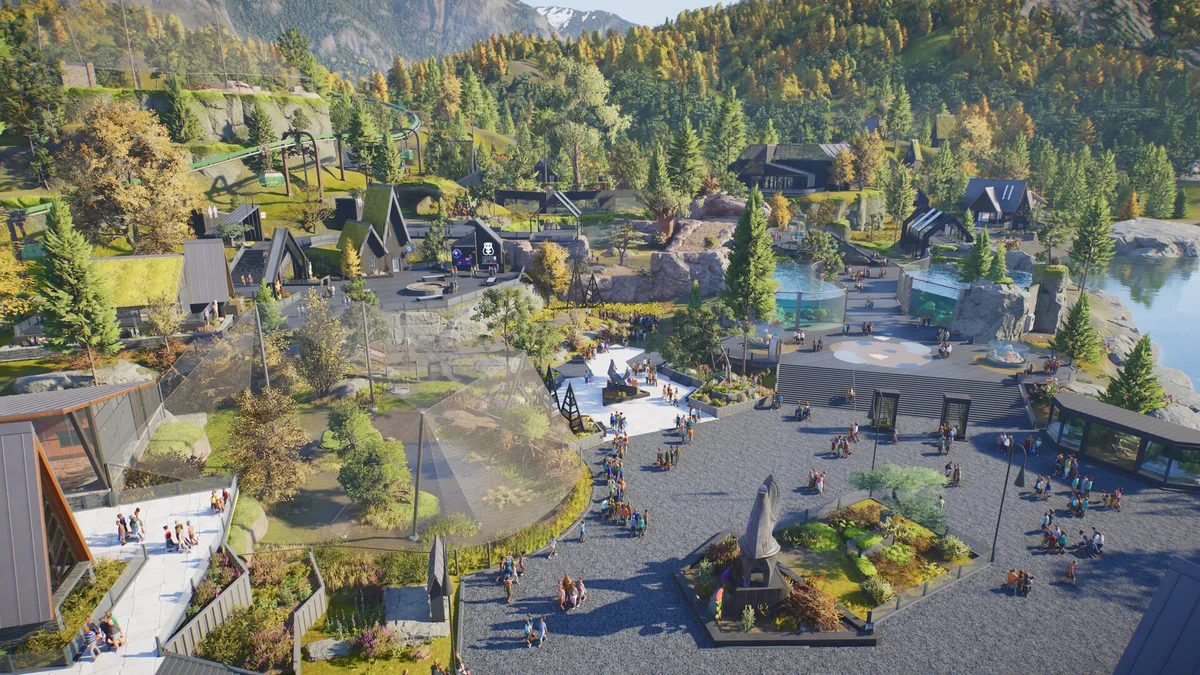
Shops and amenities are the confirmed backbone of guest spending. Guests arrive with money and spend it on food, drinks, and souvenirs as they move through your zoo — but only if your facilities are where the guests actually are.
Placement rules that hold in every Planet Zoo game and carry into the sequel:
- Facilities go on main paths, not side paths. A shop at a junction outsells a shop at the end of a dead end by a wide margin.
- Cluster, don’t scatter. One plaza with a drink stand, a food outlet, and a souvenir shop serves the same foot traffic three ways. Three isolated buildings each pay their own staff and upkeep for a fraction of the traffic.
- Match supply to demand. Facilities have running costs. A shop with no queue is either perfectly placed or over-served; a shop with a long queue is under-served. Adjust until queues are short and steady.
Amenities — toilets, benches, bins, shelters — do not earn directly, but they extend guest visits. A guest who sits, eats, and relaxes stays longer and spends more before leaving. Think of amenities as income infrastructure with a delayed payoff.
Why Does Education Increase Income?
Education is officially confirmed as a mechanic, and it is the most underrated income lever in the series. Educational opportunities — boards, speakers, and related displays near habitats — raise guest happiness and their appreciation of your animals. That appreciation feeds into your zoo rating, and rating is the engine of the whole loop.
The pattern to copy: place an education element at every habitat’s best viewing spot, and put a facility cluster within a short walk of it. Educated guests linger at windows, lingerers walk past shops, and walkers buy things. Education does not appear on the income ledger directly, but it shows up in everything that does.
Our beginner guide sequences this for your first three hours if you are starting fresh.
Can You Breed Animals for Profit?
Yes — with nuance. Planet Zoo 2 supports breeding programs, and in Franchise mode you can trade animals with other players, which is officially confirmed. That creates a real animal economy: well-bred offspring from good genetic lines have value to other players building their own collections.
The franchise trading loop works like this:
- Build habitats where welfare is consistently high, because welfare gates breeding success across the series.
- Raise offspring to maturity while managing the four welfare pillars — nutrition, social, environment, enrichment.
- Trade surplus animals on the Franchise market for credits, and reinvest in new species or better facilities.
Two honest caveats. First, exact breeding rates, gestation times, and market prices are the subject of active community testing — this section updates as data firms up. Second, animal trading rewards patience, not volume. A handful of high-welfare, genetically valuable animals beats a barn full of mediocre ones.
It is also worth planning your breeding pairs deliberately from the start. Every animal you buy is a long-term investment in a bloodline, and replacing a poorly chosen founder later costs far more than choosing well the first time. Look at temperament, genetic diversity, and how the species fits your existing habitats before adding it to the market watchlist.
Breeding also ties into conservation value — species that are hard to breed are prized for exactly that reason. If trading animals is your endgame, Franchise mode is where Planet Zoo 2’s economy has the most depth; Career mode instead pays you through scenario objectives.
What Should You Spend Money On First?
Early money is scarce, and misallocation is the number one cause of bankrupt zoos in the series. Priority order for a new zoo:
- Animal welfare first. Food, keepers, and enrichment before anything cosmetic. Welfare problems compound into rating problems, and rating problems are income problems.
- One facility cluster. Enough shops and amenities to monetize your existing foot traffic — details in our habitat design guide if you want layouts that place facilities naturally.
- Education at each habitat. Cheap, permanent, and rating-positive.
- Only then, the next habitat. Each new habitat should be funded by the income of the ones before it.
The single biggest trap is building ahead of demand: a second habitat before the first one pays for itself, or a grand entrance before there is a zoo worth entering. Follow the loop — build, attract, rate, earn, expand — and the economy takes care of itself.
If you are playing Career mode, the same priorities apply, but scenario objectives will periodically inject bonus income — treat those injections as acceleration, not as a reason to skip the loop. Sandbox mode players can ignore income entirely, but the loop still matters as a design discipline: a zoo built to be economically self-sustaining is usually a zoo guests can actually navigate.
Related Articles
game-modes
Planet Zoo 2 Franchise Mode: Long-Term Zoos and Player Trading
Planet Zoo 2 Franchise mode challenges you to run a zoo for the long term and trade animals with other players. Here is how its economy works.
guides
Planet Zoo 2 Aquatic Animals Guide: Aquariums Done Right
Complete Planet Zoo 2 aquatics guide: freshwater vs saltwater aquariums, confirmed species like Blacktip Reef Sharks, water care, and tank design tips.
guides
Planet Zoo 2 Beginner Guide: Your First 3 Hours
A timeline-based Planet Zoo 2 beginner guide covering your first three hours: tutorials, your first habitat, guest facilities, economy, and breeding.
Was this helpful?
Thanks for the feedback!