Planet Zoo 2 Blacktip Reef Shark: How Aquatics Change Zoo Design
Planet Zoo 2 blacktip reef shark guide: the launch roster’s reef ambassador, saltwater aquarium design, water gates, filtration and shark welfare.
Quick answer: The blacktip reef shark is one of the flagship species of Planet Zoo 2’s biggest new feature — fully aquatic animals. Confirmed in the launch lineup, this Vulnerable Indo-Pacific reef shark needs a proper saltwater aquarium with rated barriers, a water gate for staff and filtration to hold water quality, and it lives best in a loose group of up to ten. Breeders can chase two rare colour morphs: leucistic and piebald.
What is the blacktip reef shark in Planet Zoo 2?
The official Zoopedia describes the blacktip reef shark (Carcharhinus melanopterus) as a medium-sized shark of Indo-Pacific reefs and coastal waters, named for the black tips of its fins — and careful to distinguish it from the similarly named blacktip shark (C. limbatus). Males measure 0.9–1.6 m; females are larger at 1–1.8 m and 8–10 kg. The Zoopedia lists it as Vulnerable, citing overfishing, bycatch sold into the fin and meat trade, and climate-driven coral reef loss.
| Fact | Detail (official Zoopedia) |
|---|---|
| Scientific name | Carcharhinus melanopterus |
| Conservation status | Vulnerable |
| Class / Order | Chondrichthyes / Carcharhiniformes |
| Biomes | Estuarine, Mangrove, Reef |
| Native range | Indo-Pacific reefs and coasts |
| Temperament | Confident |
| Social group | 1–10, loosely social |
| Colour morphs | Leucistic, piebald |
How do aquatics change zoo design?
This is the question the whole sequel turns on. In the first Planet Zoo, water in a habitat was terrain; in Planet Zoo 2, sharks like the blacktip reef shark need aquarium habitats — a glass-walled tank that guests view from outside while the animal lives entirely underwater. Building one changes your zoo on three axes:
- Construction. Aquariums use rated barriers, a dedicated water gate so keepers can enter and maintain the tank, and a filtration system that actively manages the water. Reef species like the blacktip reef shark are listed for reef, estuarine and mangrove setups, so theming a coastal building around the tank is the natural move.
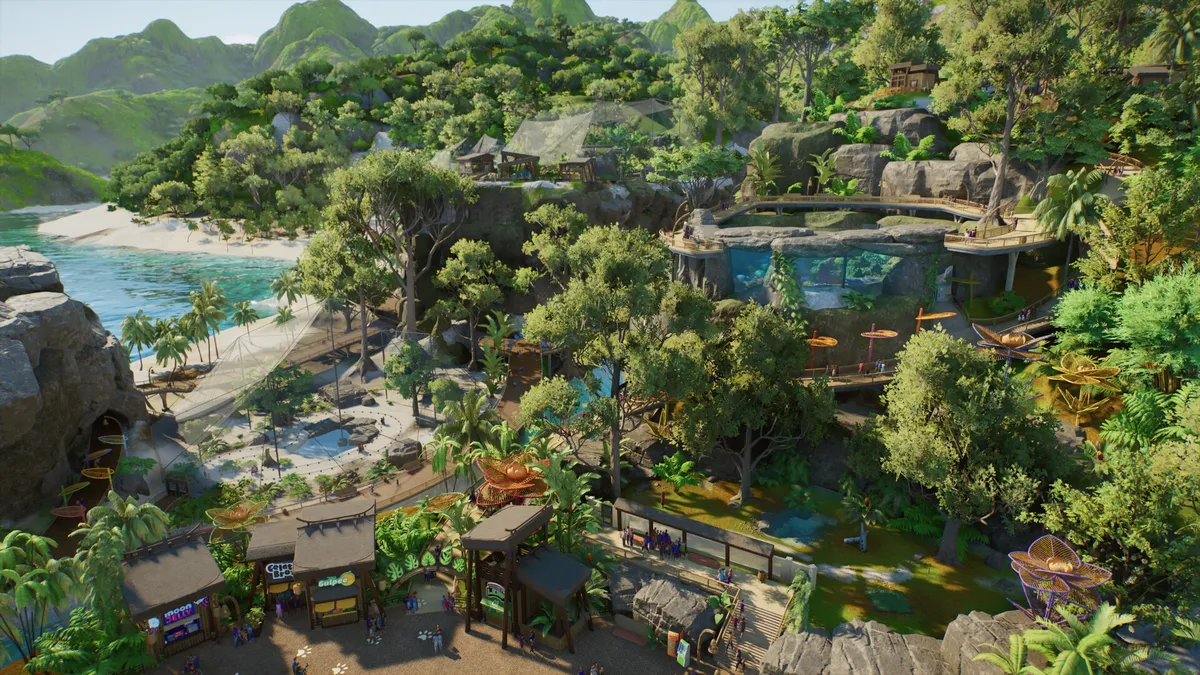
- Guest flow. An aquarium is a destination, not a pen. Frontier’s own coastal zoo footage shows guests clustering along aquarium glass — plan paths, viewing galleries and space for crowds the way you would around a flagship habitat.
- Staffing and upkeep. Water gates, filters and tank maintenance replace the fence-and-ranger loop of land habitats, and feeding happens into water rather than onto terrain.
Our aquatic animals guide walks through the full aquarium system, and the habitat design guide covers sightlines for the viewing galleries around it.
How do you manage saltwater water quality?
Honest answer first: Frontier has not published official figures yet for Planet Zoo 2’s water chemistry values — salinity targets, acceptable ranges or filtration rates. Community testing is underway and this section will be updated as verified numbers emerge.
What is confirmed by the official materials is the shape of the system: aquarium habitats need filtration equipment to keep the environment healthy, barriers rated for the species, and a water gate for staff access. The blacktip reef shark’s Zoopedia also lists mangrove and estuarine biomes alongside reef, giving you some flexibility in how you theme the tank — a mangrove-root lagoon and an open reef wall are both defensible builds.
Which tank theme suits the blacktip reef shark?
The Zoopedia’s biome list — reef, estuarine and mangrove — gives you three defensible looks. A coral-reef wall with schooling bannerfish, clown anemonefish and yellow tang is the classic: the shark herds those same species’ wild counterparts, so guests watch the hunting strategy in miniature. A mangrove lagoon pairs well with the species’ nursery story, since the Zoopedia notes that females give birth in shallow areas used by many sharks. Estuarine theming suits a mixed coastal building where the aquarium sits beside a lion habitat.
Whatever theme you pick, budget for the whole system, not just the glass: rated barriers sized for a Grade 2, 1 m-rated shark, a water gate your keepers can actually reach, filtration equipment in a service corridor, and viewing space deep enough for crowds to gather without blocking the path. Sharks are among the most expensive animals to house at launch, and Frontier has not published official figures yet for running costs or water-quality targets; community testing is underway and this section will be updated.
How do blacktip reef sharks behave?
The Zoopedia calls them loosely social — they swim together even when not hunting, and they hunt cooperatively, herding schools of fish into tight spaces to feed more effectively. A planned group of up to ten suits that behaviour: solitary sharks will do fine, but a small group shows off the species’ signature movement. It also notes their vision is poor, with prey detection driven by movement and smell — one reason these sharks are famously curious rather than aggressive around divers.
Reproduction is live-bearing (viviparous), with a long seven-to-eleven-month gestation depending on water temperature and litters of two to five pups born in shallow nursery areas. The Zoopedia rates reproduction difficulty as Easy, so a breeding pair will eventually reward patience — with a chance of leucistic or piebald pups. Juveniles grow fast for two years, then slow to about 5 cm per year; maturity arrives at 4–5 years for males and 7–8 for females. In a well-stocked tank the group dynamics alone — loose schooling, occasional herding bursts — are worth the price of admission, which is why this species headlines Frontier’s own aquatic showcases.
Why breed sharks at all?
Conservation, money and spectacle in one package. The Zoopedia frames the species as a keystone predator on its reef — essential to the food web — which is why its conservation text highlights marine protected areas, reef restoration and successful captive breeding reintroductions in the South Pacific. In-game, a shark tank is among the most dramatic exhibits you can build, and rare morphs turn it into a breeding programme guests will cross the map to see. Pair it with other aquatics from the full animal list — the West Indian manatee and clown anemonefish fill very different niches in the same coastal zone — and check our update tracker as Frontier publishes more on aquarium systems post-launch.
Related Articles
guides
Planet Zoo 2 Aquatic Animals Guide: Aquariums Done Right
Complete Planet Zoo 2 aquatics guide: freshwater vs saltwater aquariums, confirmed species like Blacktip Reef Sharks, water care, and tank design tips.
animals
Planet Zoo 2 African Wild Dog: Pack AI and Social Needs Guide
Planet Zoo 2 African wild dog guide: pack hunting behaviour, social group management, and how to release painted wolves to the Great Rift Valley reserve.
animals
Planet Zoo 2 Animals: Complete List of All 130 Species
Every Planet Zoo 2 animal at launch: all 130 species grouped by class with real-world conservation status, plus the new aquatics and flying birds explained.
Was this helpful?
Thanks for the feedback!