Planet Zoo 2 Flying Birds Guide: Building Your First Aviary
How to build walk-through aviaries in Planet Zoo 2: barriers, support poles, and dynamic mesh covers explained, plus confirmed birds like the Toco Toucan.
Birds that actually fly are one of Planet Zoo 2’s two headline additions, alongside aquatic animals. Instead of placing a pre-built aviary from a menu, you construct walk-through enclosures from parts — and that construction system has a learning curve. This guide walks through it using only officially confirmed mechanics.
How Do Aviaries Work in Planet Zoo 2?
Classic habitats in the Planet Zoo series use barriers: pick a fence, draw a loop, done. Aviaries extend that idea into three dimensions. Frontier has confirmed three building elements that work together:
- Barriers — the same barrier tools you know from terrestrial habitats, forming the walkable perimeter guests enter through.
- Support poles — structural elements that hold up the covering above the enclosure. The bigger your aviary footprint, the more pole placement matters.
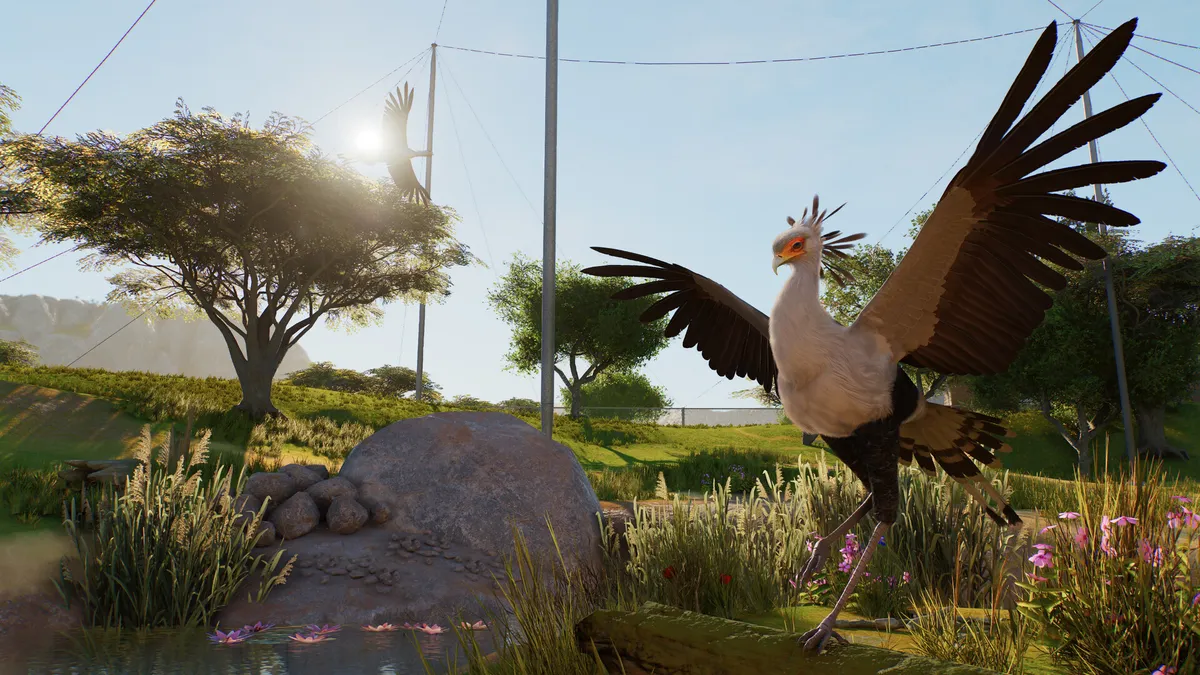
- Dynamic mesh covers — the roof itself. The mesh is dynamic, meaning it forms over the space defined by your barriers and poles, creating a sealed volume that keeps flying birds inside while letting light through.
The result is a walk-through habitat: guests enter through a gate and share the airspace with free-flying birds. It is the closest Planet Zoo 2 gets to Wildlife Reserves inside a traditional zoo.
Barriers, Poles, or Covers: Which Matters Most?
All three, but for different failure modes.
Barriers control the boundary. They determine which species can be housed, where guests enter, and how the habitat reads from outside. Because guests walk inside, barrier-guest interaction matters more than in a standard enclosure — sightlines, entry flow, and pinch points all affect guest happiness inside the aviary.
Support poles are the least intuitive part. Poles carry the mesh, and their placement shapes the internal volume. Crowd poles and you obstruct flight paths and sightlines; spread them too far and the mesh span looks wrong or fails to close. Until the community maps exact limits, the safe heuristic is: keep pole spacing regular and keep poles away from the center of flight lanes. Community testing is underway, and this section updates as data firms up.
Dynamic mesh covers seal the habitat. Because the mesh is generated dynamically from your structure, the enclosure volume is flexible — you can build anything from a small tropical house to a vast walk-through savanna canopy. The tradeoff is that every design choice propagates: change the barriers and the cover recalculates.
A useful mental model is a greenhouse: barriers are the walls, poles are the frame, and the mesh is the glass. Each element is simple on its own, but the volume only works when all three agree. Plan the footprint first, place poles second, and adjust the mesh last — rebuilding in that order avoids the frustration of a cover that will not close over a structure you already love.
Which Birds Are Confirmed for Planet Zoo 2?
Frontier has officially confirmed these flying birds in trailers and feature presentations:
- Toco Toucan — the large, unmistakable toucan with the oversized orange bill, shown in tropical aviary settings. It is the confirmed flagship flying bird.
- Secretarybird — a ground-hunting bird of prey famous for stomping snakes, shown dramatically inside a meshed aviary. Despite spending much of its time on the ground, it requires the full aviary treatment.
Other species continue to be revealed — check the animal reveals tracker and the full animal list for the current lineup. The confirmed pattern so far: aviary species mix strong fliers with ground-dwelling birds, which changes how you use vertical space.
How Do You Manage Flying Bird Welfare?
Welfare in Planet Zoo 2 rests on four confirmed pillars: nutrition, social needs, environment, and enrichment. Flying birds stress all four harder than most terrestrial species.
Nutrition is standard keeper work, but aviaries are 3D — food stations placed only on the ground underserve arboreal feeders. Spread feeding stations across perches and ground level.
Social needs scale with flocking behavior. Birds shown in trailers move in groups, and the series convention is that social species decline in isolation. House birds in pairs or groups unless the species profile says otherwise.
Environment is where aviaries differentiate. Flying birds need airspace — a tall, unobstructed volume — plus vegetation or structures at varied heights. A flat, empty aviary with a high ceiling is worse than a shorter one with layered perches and canopy.
Enrichment should match behavior: perches, baths, and foraging opportunities for arboreal species; open ground and hunting stimuli for the Secretarybird. Our habitat design guide covers enrichment placement in more detail.
One more confirmed-series practice that carries into Planet Zoo 2: guests inside the aviary react to what they can actually see. Dense, layered habitats photograph and review better than bare volumes.
A final thought on sizing: because the mesh cover is generated from your structure, you can iterate cheaply. Build a conservative first aviary, watch where your birds actually fly for a few in-game days, then expand the volume along their preferred routes. Flying birds tell you their design requirements through behavior — use that feedback loop instead of guessing on day one.
What Mistakes Should You Avoid?
Three errors account for most failed first aviaries:
- Building too small. Birds need horizontal flight distance, not just height. If the mesh closes over a space you would not jog across, it is too small.
- Ignoring pole placement in flight lanes. A pole in the middle of the main flight path is a constant welfare drag.
- Treating the aviary as a sideshow. A walk-through aviary is a guest magnet — put facilities at the exit and education inside, the same logic covered in our money-making guide.
If you are building your first aviary as part of a new zoo, sequence it after your economy is stable; the beginner guide lays out that order. And if birds make you want more open-space design, aquatics offer a parallel challenge — see the aquatic animals guide for the sequel’s other headline system.
Related Articles
building
Planet Zoo 2 Blueprints Guide: Ready-to-Place vs Piece-by-Piece
Planet Zoo 2 blueprints let you place pre-built designs instantly, or build piece by piece with scaling, flexi-colour and pathing tools. Here is when to use each.
building
Planet Zoo 2 Habitat Design Guide: Welfare, Terrain and Foliage
Design better habitats in Planet Zoo 2 with this guide to terrain and foliage brushes, water, real animal behaviour and the four pillars of animal welfare.
building
Planet Zoo 2 Scenery Themes: 4 New Themes and 5 Returning
Planet Zoo 2 confirms four new scenery themes and five returning from Planet Zoo, with iconic architecture across globe-spanning biomes. Here is what each offers.
Was this helpful?
Thanks for the feedback!